Meditation according the the 5th Epochal Revelation by Peter Holly Part 2

MEDITATION 2 | Jesus-Style Meditation (previous) | Meditation or Mysticism? | Stillness Practice Is Not In The Urantia Book | Stilled Mind Meditation Is Lacking | Dangerous Ground | Transcendental Meditation vs. Jesus-Style Meditation | Keeping Up with Evolving Words |
Jesus-Style “Meditation”:
What the word really means! (Continued:)
“Worshipful Meditation” vs. Thought-Stilling Techniques
When all self-centered desires are lacking, prayer transforms into worship, “sublime thinking” into “superthinking” (ref. 1616 D). Otherwise they are identical where they overlap. At the point worship begins we basically just hang on for the ride, but this does not mean that our minds are quiet or without thoughts. Far from it. Our Thought Adjuster is “conducting” the worship.
“The more healthful attitude of spiritual meditation is to be found in reflective worship and the prayer of thanksgiving”
For us at this time (in this state) “worship is effortless attention, true and ideal soul rest, a form of restful spiritual exertion” (1616 D).
 “Under no circumstances should the trancelike state of visionary consciousness be cultivated as a religious experience.” (1099 D)
This is because while the thoughts we have then seem to be our own, they are actually being produced -- not without our own unconscious distortions (see 1786 D) -- by our Thought Adjusters and the Spirit of Truth. Cause these thoughts to cease and communication stops!
“If one is disposed to recognize a theoretical subconscious mind as a practical working hypothesis in the otherwise unified intellectual life, then, to be consistent, one should postulate a similar and corresponding realm of ascending intellectual activity as the superconscious level, the zone of immediate contact with the indwelling spirit entity, the Thought Adjuster.” (1099 C)
“Ascending intellectual activity” is diametrically opposed to the stillness-minded intellectual inactivity practiced in Eastern Religion-style meditation.
The only place in the whole URANTIA Book where anything at all in the nature of non-intellectual functioning, passive-minded contemplation is advanced, which I have been able to discover, is where we are instructed by Jesus that after we have made our prayers to the Father, we should “remain for a time in silent receptivity to afford the indwelling spirit the better opportunity to speak to the listening soul” (1641 A). Notice that the spirit speaks to the soul, however, and not to the mind or consciousness of the praying person. This is quite different from hearing “voices”. This is neither prayer nor worship, and it is not “meditation”. It is a few moments of quietude to be imposed before quitting! It is to augment the transition into worship over time, so that one who now merely says his prayers will later be able to continue them on into worship, which is the goal. Ideally the transition of the moment is seamless, we simply segue from the one into the other. The line between prayer and worship is self-interest. (ref. 65 D)
“The ideal prayer is a form of spiritual communication which leads to intelligent worship.”
Admittedly the doorway to mental quietude is cracked open by Jesus’ instruction, but hardly wide enough to admit the full panoply of Eastern-style meditation! Actually all that Jesus is saying is that we should shut up and listen for a moment after praying before returning to our ordinary thoughts and activities. There is no indication whatsoever that we can expect to be, or should become aware of any aspect of this particular transaction between our soul and Thought Adjuster, but as we more and more become our souls, that is, as we personally grow over time to identify ourselves with our higher self, the more we should obviously be able to “hear”:
“The material and mortal reality of the self transcend[s] the temporal limitations of the physical-life machine and attain[s] a new expression of a new identification in the evolving vehicle for selfhood continuity, the morontia and immortal soul. (1218 D)
This evolution of one’s soul/self identification cannot be achieved by any short-cut methods, including thought-stilling techniques! Jesus knew:
“the futility of the Caligastia method of trying to get ahead of the natural, slow and sure way of accomplishing the divine purpose.” (1521 A)
“Never, in all your ascent to Paradise, will you gain anything by impatiently attempting to circumvent the established and divine plan by short cuts, personal inventions, or other devices for improving on the way of perfection, to perfection and for eternal perfection.” (864 C)
Quite plainly we are taught that:
“There is no other technique [than prayer] whereby every man, regardless of all other mortal accomplishments, can so effectively and immediately approach the threshold of that realm wherein he can communicate with his maker … with the indwelling Thought Adjuster.” (1000 A)
“The ideal prayer is a form of spiritual communication which leads to intelligent worship”(1618 D).
“When Jesus taught his associates to pray in the spirit and in truth, he explained that he referred to praying sincerely and in accordance with one’s enlightenment, to praying wholeheartedly and intelligently, earnestly and steadfastly” (1640 C).
Jesus’ instruction for a receptive moment after prayer does not appear to apply to people who are at the point of entering from prayer into worship, but rather to those whose spiritual communications seldom if ever rise to the level of worship. It appears to be a method of preparing a worshipful attitude of mind over time. This directive was presented in a list of sixteen instructions (beginning on page 1638) concerning -- except for this last point in the list -- prayer. Jesus brought that subject from the sub-level of (1) “conscious and persistent regard for iniquity”; through (3) “opening the God-man communication”; to the few moments (“a time”) of (16) “silent receptivity”. Then he touches upon the higher level of a beginning understanding of worship, which, unlike prayer, is not described in detail there. We are told that while he did teach more at this point, “not many … could fully encompass his teaching”. We should understand that Thought Adjusters at that time had not yet been universally bestowed, so worship -- including understanding of the subject -- might have been particularly difficult for these people, even though they were twenty-four of Jesus’ closest followers. This event took place, after all, during his first preaching tour of Galilee. Not long before this they were unable to grasp even more than a few of the conceptual differences between prayer and worship which Jesus attempted to teach them (ref. 1616 B). It should not be overlooked, either, that although they did have the presence of the physical Jesus, he could not be with them 24 hours a day or in their minds when they prayed, worshipped, or meditated. The Spirit of Truth would not be poured out until after Jesus’ departure.
For ourselves, if we access this now universally available spirit resource, worship should come much easier -- it is obviously a stage or ability which must be attained before “worshipful meditation”, or Jesus-style meditation can take place. But stilling one’s thoughts is hardly the way to open the door to the “realm of the highest and most spiritualized thinking”.
“Nothing which human nature has touched can be regarded as infallible.”
Meditation or Mysticism?
We are indeed told that mysticism, as the “technique of the cultivation of the consciousness of the presence of God” -- which is virtually identical to the 1934-1935 definition of the word -- “is altogether praiseworthy” (1000 A). But that “however favorable may have been the conditions for mystic phenomena, it should be clearly understood that Jesus of Nazareth never resorted to such methods for communication with the Paradise Father” (1100 A), and “the direct communion with one’s Thought Adjuster, such as occurred in the later years of Jesus’ life in the flesh, should not be confused with … so-called mystical experiences” (1100 A). And, as well, that when mystical practices “lead to social isolation and culminate in religious fanaticism, they are all but reprehensible. (1000 A). We are clearly and most specifically warned by The URANTIA Book that “under no circumstances should the trancelike state of visionary consciousness be cultivated as a religious experience” [this “mystical state” is defined therein as “diffusion of consciousness with vivid islands of focal attention operating on a comparatively passive intellect” -- in short, thought-stilling, so-called “meditation”] (1099 D). Rather than using the “mystical” approach -- regardless of how “praiseworthy” -- “the more healthful attitude of spiritual meditation is to be found in reflective worship and the prayer of thanksgiving”. (1100 A) Prayer, Jesus said, “is designed to make man less thinking but more realizing; it is not designed to increase knowledge but rather expand insight”(1616 C). That is, we begin to realize the truth-content of the thoughts which are formed in our minds by the work of the Spirit of Truth and our Thought Adjusters, yet which seem to be our own -- again, this hardly implies a quiet mind! It is, we are told quite plainly, our “thoughts” that lead us “Godward”. “The divine spirit makes contact with mortal man … in the realm of the highest and most spiritualized thinking” (1104 D - 1105 A). The intellect is active during worshipful meditation -- “Jesus-style meditation” -- but we are no longer in charge. This does not mean that the thoughts (as opposed to “voices” etc.) which we perceive can be expected to be entirely free of our own, personal, distortions -- they cannot! Yet these distortions will become minimized over time as we continue with the process of spiritualization (or more precisely, “morontialization”).
Stillness Practice Is NOT In The URANTIA Book
If Jesus’ instruction to pause receptively did somehow refer to Eastern-style, stilled intellect, passive-mind “meditation”, why are we not clearly informed of this either there or elsewhere in The URANTIA Book? Why would it be presented virtually as a secret and hidden instruction only to be made understandable by purported spiritual communications -- channellings, a phenomenon that has been associated with dissociation -- which The URANTIA Book did not apparently foresee, but which were to take place before even the century of its reception had passed, thus effectively outdating essential truths of a millennial or bi-millennial (1,000 or 2,000-year) revelation in less than sixty years? While it is true that the contact personality (ref. 865 A), who was instrumental in the reception of The URANTIA Book, transmitted early materials by way of something like “channelling” (before the Urantia Papers and their prototypes were physically materialized), it should be clearly understood that by all reports he made no special preparation of his mind or self before being so-used by the revelators, and that he was unconscious and unaware (asleep) during the whole procedure. According to those who were present and recorded these night-time sessions, he did not even know anything had happened until told about it when he regained consciousness. His experience had nothing to do in any way with any kind of “meditation”. Neither were there apparently any direct benefits to the sleeping individual from the night-time sessions. Exactly how his mind may have been used by supernals in downloading and printing-out (materializing) the hardcopy text of the Papers, is completely unknown, although secret, human technology developed only after the Urantia Papers were received and published -- is believed to exist whereby a sleeper’s visual cortex (where dreams are pictured) can be accessed wirelessly for both input and display by a remote computer. My guess is that supernals used something way beyond our possibly ahead-of-the-state-of-the-art, materialistic, secret technology to employ the sleeper’s mind like a word processor, in which he pictured the text in his own default font: pencil handwriting. This seems more realistic than Bill Sadler’s (William Sadler’s son’s) idea of an invisibly-held pencil actually writing the pages out in forged longhand, to account for the fact that they were in the subject’s own cursive script. (It was so much in his own hand that he was reported to have joked that his bank balance was in danger.) Nor should we overlook the fact that beyond his being “favorably constituted” (ref. 1258 A), his was “one of the highly experienced Thought Adjusters of his day and generation”. And that even aside from being unconscious during the actual process, at other moments the contact personality was “consciously quite unconcerned about the entire procedure” and exhibited a “passive reaction to, and inactive concern towards, the phenomena associated with the presence in his mind” of his especially versatile Adjuster. This is described as a “rare” and “fortuitous” reaction, which was highly favorable to the individual from the standpoint of “health, efficiency, and tranquility” (ref. 1209 A). Notice that it was his attitude which was favorable, not the experience of transmission, and that the information received by the channelling-like activities were superseded by materialized Papers -- hard copies in black and white -- which being thus received contained less mentally-imparted distortions than those which probably (if they impinged upon and thus been tinged by his imagination or dreams) would have colored the earlier product of channelling-like activities utilizing the sleeping contact personality’s vocal apparatus (see 1208 A) unless they were using him like a hand puppet and bypassing his mind completely. But if they were doing that, why was his extremely versatile Thought Adjuster needed: just to stand aside while he was “possessed”? Even then, such “possessions” are not likely to be complete and total. Personality distortions would still seep through. Obviously the room for such distortions is much greater in cases where the channeller is just trying to keep up with some sort of inner, vaguely heard “dictation”. It should also not be ignored that Dr. Sadler used every art and artifice at his command to “debunk” the channelling-like activities as well as the materialized Papers and “instructions” or “mandates”, which were also received. He made sure that no known means of trickery was involved. Such safeguards have been entirely lacking in regards to the Teaching Mission (TeaM) and other purported communications, such as those of Emma “Christy” Christensen after the middle 1950s when the “you are on your own” message was received -- thus ending direct supernal contact and supervision -- and of Vern Grimsley in the early 1980s immediately following Christy’s death. In all of these cases there has been no objective look at the possibility of technological or other trickery, or -- as in the case of Vern Grimsley -- more than a superficial look at psychological explanations … at least none by the actual participants or their supporters, who all, decidedly unlike Sadler, seem to take everything at face value! Again, we need to ask why exactly those phenomena which passive-intellect meditation induces would be precisely those which we are told that Jesus-style meditation does NOT include: “leadings, voices, [and] visions” (2089 B)? and "feelings or emotions”, which do NOT lead us Godward, according to The URANTIA Book. While the practice of passive-intellect meditation was little-known in America at the time the Papers were indited into English, it was not unknown; and it had been prevalent in India and elsewhere for at least hundreds of years. This was not some new concept for which the world was in no way ready, which needed to be later revealed by way of auto-(or continuing) revelation. Why would there be only such a meager indication that it was so if Jesus’ instruction for a quiet, receptive pause at the completion of prayer were indeed a reference to thought-stilling meditative practices? We are told that the revelators used: “more than one thousand human concepts representing the highest and most advanced planetary knowledge of spiritual values and meanings … assembled from God-knowing mortals of the past and present” (17 A). Why -- if it is as important as some claim -- was such a purportedly valuable process excluded except, perhaps, for hints in a revelation which makes so many things so plain and which repeats key concepts almost ad infinitum? Even this confusion about the definition of “meditation” would not exist if the context of the book were observed. It explains it all very well, indeed! The problem arises only because the meaning of the word itself changed, causing people to encounter the word with a wrong idea about it already fixed in their minds, or as a result of being directed to the word by channelled purported spirits as “proof” that meditation is considered important by the supernal revelators, in an attempt to justify stilled-mind practices! Since there are rewards from (therefore reinforcing) semi-trance states (see below), simple classical conditioning makes the practice difficult to give up once started. And The URANTIA Book teaches that “it requires a great and noble character, having started out wrong, to turn about and go right. All too often one’s own mind tends to justify continuance in the path of error when once it is entered upon” (1981 D). If, in fact as we are informed, the supernal revelators were mandated by their superiors to utilize existing expressions even where these more or less distorted the truth which they represented (ref. 1 C) -- almost the very first words in The URANTIA Book -- what possible reason could have caused the revelators to give such short shrift -- hardly more than a passing honorable mention, if even that -- to further elucidation of the Eastern religion’s method of passive-mind meditation? If that was what the Master had in mind? Rather, isn’t the truth contained in this idea: Jesus spent the “long hours of that night of meditation” “thinking, thinking”? Not zoned-out in a semi-trance state listening to “voices” and feeling “love”? Not only are we warned against such purportedly “religious” experiences, and told that they were not part of Jesus’ religion, but now more and more they are being proved to be productions of the electro/chemical anatomical apparatuses in the brain -- meat-reactions of the brain, predictably evocable by scientific tweaking! The subjective feeling of “awareness” or lack-of-trance in such states can be deceptive as well. Hypnotists report that subjects whom objective measurements assure them have been put into in trances often afterwards refuse to believe it, even though the subjects also followed the hypnotist’s “suggestions” while apparently -- as also assessed by the experienced hypnotists -- hypnotized. The problem is that the trance state is not necessarily easily discernable from within. And to compound the problem of subjective recognition it is merely semi-trance states which The URANTIA Book warns can be spiritually dangerous. These are more than likely even less discernable than full, hypnotic trances! But we know when our mind is “comparatively passive”, and when our awareness is focused only upon “vivid islands” and not our wider consciousness. Outwardly this condition may only be signaled by widely dilated pupils, which apparently are known to accompany elevated alpha wave levels. It has been discovered that the more these states are entered into, the longer they will persist, carrying over beyond the period of meditation, even into day to day activities. Elevated alpha levels also indicate that the mind is highly suggestible and lacking in abilities of discernment and cognition (you naturally experience this state just before falling asleep -- which fact in itself is evidence that the alpha-state is closer to the subconscious, dream-state, than to the superconscious “mountaintop of intellectual activity” which is the area of immediate contact with the indwelling, spirit God-fragment within us). We are quite likely soon to be overwhelmed with new knowledge in this area when more results of the ongoing international, cross-discipline mapping study of the brain are brought to public awareness.
Stilled Mind Meditation Is Lacking
This is not to say that Eastern-style, so-called, “meditation” has to be considered harmful in and of itself. Scientific scrutiny has apparently observed beneficial effects from its practice. The URANTIA Book in no way condemns it for promoting better health and release from stress. What it does warn is this:
“Under no circumstances should the trancelike state of visionary consciousness be cultivated as a religious experience” (1099 D).
The supernals explain that this “mystical state” (known more scientifically as “alpha-state”, so-
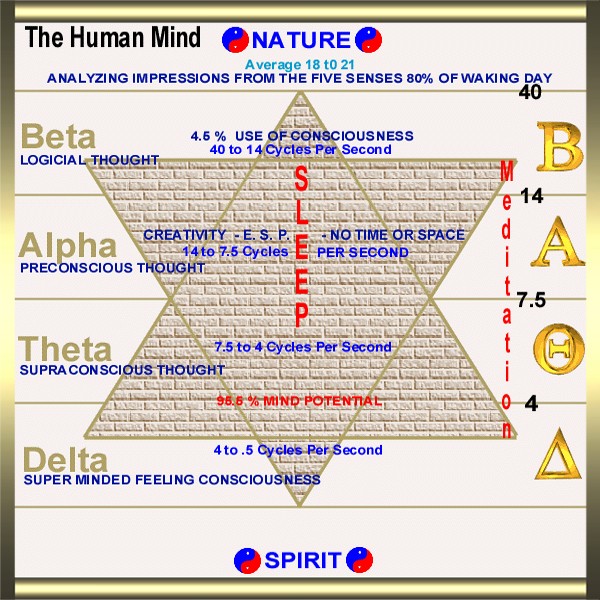 named because of the predominance of alpha waves produced therein by the brain) “gravitates consciousness toward the subconscious rather than in the direction of the zone of spiritual contact, the superconscious [the “realm of ascending intellectual activity”]”(1099 D). Like prayer, it also obviously can access the “subconscious reservoir of mortal experience” for “material aid” (997 C), but the danger is that “visions and other so-called mystic experiences, along with extraordinary dreams, may be regarded as divine communications to the human mind” (1100 A). The experiences themselves may be no more harmful than dreams, but they should not be believed!
Chart showing alpha brain-waves
On the other hand, this does not mean that we should jump right into Eastern Religion’s so-called “meditation” for non-religious purposes without exercising any caution. Some scientific studies have indicated a harmful effect. Also, The URANTIA Book says that “the factors which contribute to the initiation of mystic communion are indicative of the danger of such psychic states” (1100 A). And the listed factors include “dissociation”, a psychological term indicating a certain kind of loss of touch with physical/mental reality, or parts of it. Dissociation is associated with not only channelling, but with both multiple personality disorder and schizophrenia as well. The trancelike state comprising stilled-mind practices itself may be dissociative, and should be thoroughly understood if it appears in any way to be a:
“diffusion of consciousness with vivid islands of focal attention operating on a comparatively passive intellect” (1099 D).
I have not personally attempted stilled-mind practice, and probably won’t. Neither must I kill someone to accept that murder is wrong! The warnings in The URANTIA Book have been put there for one reason only, so that we can benefit from them. A word to the wise should be sufficient! They are ignored at one’s own risk of courting disaster. While such dangers cannot stop spiritual progression, they can seriously retard it!
Thought-stilling practices turn the consciousness
toward the subconscious mind, not the superconscious!
“Dangerous Ground”
Truth can be lost when new meanings come to substitute for former, earlier concepts and where the old meaning is meant the use of such words without proper explanation will always cause confusion. The URANTIA Book’s supernal authors were obviously aware of the fact of the evolution of language -- even school kids understand it in principle. Therefore they also presented descriptions of the meditative practices which were to be AVOIDED: “Diffusion of consciousness with vivid islands of focal attention operating on a comparatively passive intellect” (1099 D). “Mental dissociation to the level of abnormal mental manifestations” (1100 A). “Psychic dissociation” (1100 B) But if these other dangers can be avoided it is entirely true that Jesus-style “meditation” is highly desirable -- we are actually challenged: “to achieve better communication with the divine Monitor [Thought Adjuster] that dwells in the human mind. Man’s greatest adventure in the flesh consists in the well balanced and sane effort to advance the borders of self-consciousness out through the dim realms of embryonic soul-consciousness in a wholehearted effort to reach the borderland of spirit-consciousness -- contact with the divine presence” (2097 A) … … almost the last words in The URANTIA Book. However while pursuing this goal which they call the “great challenge to modern man”, they also warn us to keep in mind that: “It is dangerous to entertain the idea that every new concept originating in the human mind is the dictation of the Adjuster. More often in beings of your order, that which you accept as the Adjuster’s voice [or the voice of a spirit entity] is in reality the emanation of your own intellect. This is dangerous ground … ” (1208 D) “It is hazardous to attempt the differentiation of the Adjuster’s concept registry from the more or less continuous and conscious reception of the dictation of mortal conscience.” (1208 C) “It is extremely dangerous to postulate as to the Adjuster content of the dream life.” (1208 C) “The great danger … is that visions and other so-called mystic experiences [e.g., “leadings”, “visions”, “voices”, and other “abnormal mental manifestations”], along with extraordinary dreams may be regarded as divine communications to the human mind.” (1099 C) “There is a great danger associated with the habitual practice of religious daydreaming; mysticism may become a technique of reality avoidance … ” (1099 D) [And also:] “There is a certain danger associated with overmuch private praying which is corrected and prevented by group praying, community devotions. [Because] when prayer becomes overmuch aesthetic, when it consists almost exclusively in beautiful and blissful contemplation of paradisiacal divinity, it loses much of its socializing influence and tends towards mysticism and the isolation of its devotees.” (1001 A) The URANTIA Book also teaches that: “It is sometimes possible to have your mind illuminated, to hear the divine voice that continually speaks within you … But your unsteady and rapidly shifting mental attitudes often result in thwarting the plans and interrupting the work of the Adjusters … this ministry is also greatly retarded by your own preconceived opinions, settled ideas, and long-standing prejudices.” (1199 C) “In varying degrees and increasingly as you ascend the psychic circles (ref. 1209 B), sometime directly, but more often indirectly, you do communicate with your Adjusters.” (1208 D) “While the voice of the Adjuster is ever within you, most of you will hear it seldom during a lifetime. Human beings below the third and second [psychic] circles of attainment rarely hear the Adjuster’s direct voice except in moments of supreme desire, in a supreme situation, and consequent upon a supreme decision.” (1213 C) “With the vast majority of Urantians (earth-mortals) the Adjuster must patiently await the arrival of death deliverance: must await the liberation of the emerging soul from the well-neigh complete domination of the energy patterns and chemical forces inherent in your material order of existence. The chief difficulty you experience in contacting with your Adjusters consists in this very inherent mortal nature. So few mortals are real thinkers; you do not spiritually develop and discipline your minds to the point of favorable liaison with the divine Adjusters.” (1213 A) “You are so devoid of courageous decisions and consecrated co-operation that your indwelling Adjusters find it next to impossible to communicate directly to the human mind. Even when they do find it possible to flash a gleam of new truth to the evolving mortal soul, this spiritual revelation often so blinds the creature as to precipitate a convulsion of fanaticism or to initiate some other intellectual upheaval which results disastrously. Many a new religion and strange “ism” has arisen from the aborted, imperfect, misunderstood, and garbled communication of the Thought Adjusters.” (1207 C) With all these leadings, voices, misunderstood and garbled communications, dreams, and dangers, what are we to do? The URANTIA Book provides the answer: “In scrutinizing mental situations, safety lies only in the prompt recognition of each and every thought and experience for just what it actually and fundamentally is, disregarding what it might have been.” (1199 C) “In scrutinizing mental situations, safety lies only in the prompt recognition of each and every thought and experience for just what it actually and fundamentally is, disregarding what it might have been.” That is, if an inner voice says, for example, for us to go to such and such a place, or if we dream of such a place, we are advised NOT to conclude, “My Thought Adjuster may be (or even worse, is) telling me to go there”, but that “it was nothing more or less than the content of an inner voice or a dream … period!” Then it becomes simply another source of ideas (which is probably all it is anyway) which should be treated like any other suggestion -- according to its real value, or our best estimate thereof. We might well also keep track of the success/failure rate of emanations from that particular source. Does it prove to be trustworthy over time? “The human mind may perform in response to so-called inspiration when it is sensitive either to the uprisings of the subconscious or to the stimulus of the superconscious. In either case it appears to the individual that such augmentations of the content of the consciousness are more or less foreign.” (1000 D) “These are problems which will have to be solved through individual discrimination and personal decision. But a human being would do better to err in rejecting an Adjuster’s expression through believing it to be a purely human experience than to blunder [blunder!] into exalting a reaction of the mortal mind to the sphere of divine dignity.” (1208 C) “This is dangerous ground, and every human being must settle these problems for himself [or herself] in accordance with his [or her] natural human wisdom and superhuman insight.” (1208 D) The secret of Jesus’ unparalleled religious life was his: “consciousness of the presence of God; and he attained it by intelligent prayer and sincere worship -- unbroken communion with God -- and not by leadings, voices, visions, or extraordinary religious practices” (2089 B) … … such as are often produced by stilled-mind, so-called “meditation” techniques, and which are supposed to be, according to its proponents, valuable religious experience! “However favorable may have been the conditions for mystic phenomena, it should be clearly understood that Jesus of Nazareth never resorted to such methods for communion with the Paradise Father. Jesus had no subconscious delusions or superconscious illusions.” (1100 B). “A human being would do better to err in rejecting an Adjuster’s expression through believing it to be a purely human experience than to blunder into exalting a reaction of the mortal mind to the sphere of divine dignity.”
Transcendental Meditation vs. Jesus-Style Meditation
One of the most popular forms of passive-mind, so-called “meditation”, Transcendental
 Transcendental Meditation master, Marahrishi Mahesh Yogi.
Meditation or TM, is in fact pitched in conformity to The URANTIA Book warning against the use of such trancelike, “mystic” states for the purpose of religious experience:
“Transcendental Meditation is not a religion -- it is a technique … It supports all religions because it releases stress and purifies the mind, body, and emotions of the person who practices it.” (Maharishi Mahesh Yogi’s Transcendental Meditation: Revised and Updated Edition, by Robert Roth, 1994, Donald Fine Inc. New York)
Many benefits attributed to TM, however, are also said to be attainable from prayer and worship, or Jesus-style meditation. Rodan explained how we absorb energy during spiritual communion. He also said that:
“on every mountaintop of intellectual thought are to be found relaxation for the mind, strength for the soul, and communion for the spirit. From such vantage points of high living, man is able to transcend the material irritations of lower levels of thinking -- worry, jealousy, envy, revenge, and the pride of immature personality. These high-climbing souls deliver themselves from a multitude of crosscurrent conflicts of the trifles of living, thus becoming free to attain the consciousness of the higher currents of spirit concept and celestial communication. But the life purpose must be jealously guarded from the temptation to seek for easy and transient attainment … ” (1778 B)
Jesus (in modern terms supplied by midwayers) compared prayer to “recharging the spiritual batteries of the soul”, and worship to “tuning in the soul to catch the universe broadcast of the infinite spirit of the Universal Father” (1621 C). It provided “true and ideal soul rest”, he maintained, and that “the strain [stress] of living should be relaxed by the restfulness of worship” (1616 B). “Kingdom … believers,” he said:
“must increasingly learn how to step aside from the rush of life -- escape the harassments of material existence -- while they refresh the soul, inspire the mind, and renew the spirit by worshipful communion” (1739 D).
Notice that “worshipful meditation”, as taught and practiced by Jesus, provides something that TM does not claim: it benefits the soul! Jesus-style meditation improves the whole personality, rather than just being limited to its corporal/mental parts. This is NOT to say that proponents of non-TM brands of passive-mind meditation do not, unlike the Maharishi Mahesh Yogi, claim spiritual benefits as well -- many do. The question is whether we should believe them or The URANTIA Book!
“The life purpose must be jealously guarded from
the temptation to seek for easy and transient attainment”
Keeping Up with Evolving Words see Comment



Comments
Notes by Peter Holly