Uganda Constitution - Creating Politics With Principles
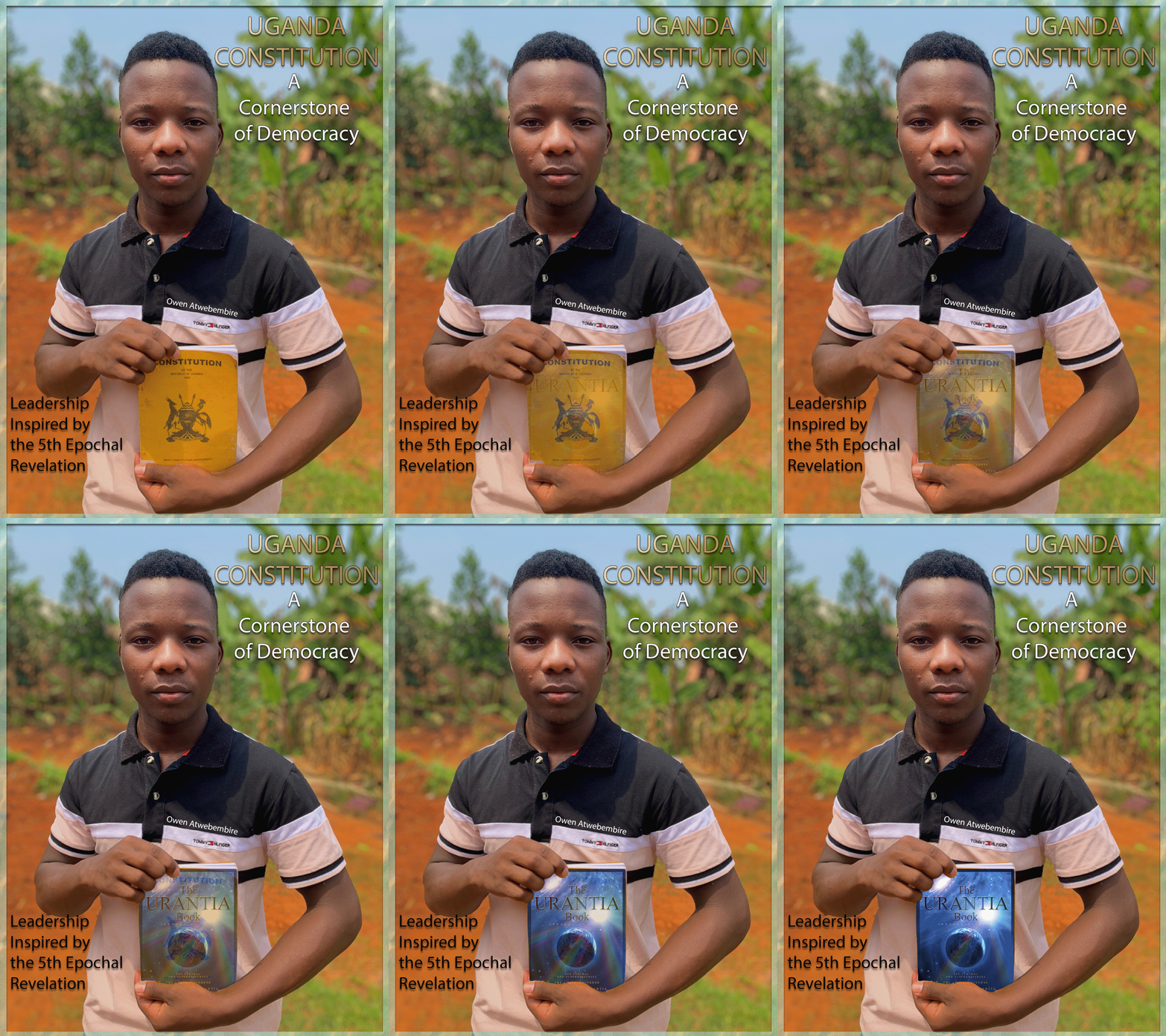
Uganda Constitution - Creating Politics With Principles
If Christianity persists in neglecting its spiritual mission while it continues to busy itself with social and material problems, the spiritual renaissance must await the coming of these new teachers of Jesus' religion who will be exclusively devoted to the spiritual regeneration of men. And then will these spirit-born souls quickly supply the leadership and inspiration requisite for the social, moral, economic, and political reorganization of the world.
6. LAW, LIBERTY, AND SOVEREIGNTY
134:6.1 If one man craves freedom -- liberty -- he must remember that all other men long for the same freedom. Groups of such liberty-loving mortals cannot live together in peace without becoming subservient to such laws, rules, and regulations as will grant each person the same degree of freedom while at the same time safeguarding an equal degree of freedom for all of his fellow mortals. If one man is to be absolutely free, then another must become an absolute slave. And the relative nature of freedom is true socially, economically, and politically. Freedom is the gift of civilization made possible by the enforcement of LAW.
The measure of the advance of society is directly determined by the degree to which public opinion can control personal behavior and state regulation through nonviolent expression. The really civilized government had arrived when public opinion was clothed with the powers of personal franchise. Popular elections may not always decide things rightly, but they represent the right way even to do a wrong thing. Evolution does not at once produce superlative perfection but rather comparative and advancing practical adjustment.
There are ten steps, or stages, to the evolution of a practical and efficient form of representative government, and these are: 1.

 Political Sovereignty and True Representative Government

Political Sovereignty and True Representative Government
Political Sovereignty and True Representative Government



Uganda Constitution Translation Project
 INDEX PAGE

 Translation Links
Arrangement of Objectives.
Objective
General.
I. Implementation of objectives.
Political objectives.
II. Democratic principles.
III. National unity and stability.
IV. National sovereignty, independence and territorial integrity.
Protection and promotion of fundamental and other human rights and freedoms.
V. Fundamental and other human rights and freedoms.
VI. Gender balance and fair representation of marginalised groups.
VII. Protection of the aged.
VIII. Provision of adequate resources for organs of Government.
IX. The right to development.
X. Role of the people in development.
XI. Role of the State in development.
XII. Balanced and equitable development.
XIII. Protection of natural resources.
Social and economic objectives.
XIV. General social and economic objectives.
XV. Recognition of the role of women in society.
XVI. Recognition of the dignity of persons with disabilities.
XVII. Recreation and sports.
XVIII. Educational objectives.
XIX. Protection of the family.
XX. Medical services.
XXI. Clean and safe water.
XXII. Food security and nutrition.
XXIII. Natural disasters.
Cultural objectives.
XXIV. Cultural objectives.
XXV. Preservation of public property and heritage.
Accountability.
3
XXVI. Accountability.
The environment.
XXVII. The environment.
Foreign policy objectives.
XXVIII. Foreign policy objectives.
Duties of a citizen.
XXIX. Duties of a citizen.
Schedules
First Schedule Kampala and Districts of Uganda.
Second Schedule The boundary of Uganda.
Third Schedule Uganda’s indigenous communities as at 1st
February, 1926.
Fourth Schedule Oaths.
Fifth Schedule Regional Governments
Sixth Schedule Functions and services for which Government is responsible.
Seventh Schedule Unconditional grant to local governments.
5
CONSTITUTION OF THE REPUBLIC OF UGANDA.
Arrangement of Articles.
Article
CHAPTER ONE—THE CONSTITUTION.
1. Sovereignty of the people.
2. Supremacy of the Constitution.
3. Defence of the Constitution.
4. Promotion of public awareness of the Constitution.
CHAPTER TWO—THE REPUBLIC.
5. The Republic of Uganda.
6. Official language.
7. Nonadoption of State religion.
8. National symbols and seals.
8A. National interests.
CHAPTER THREE—CITIZENSHIP.
9. Citizens of Uganda.
10. Citizenship by birth.
11. Foundlings and adopted children.
12. Citizenship by registration.
13. Citizenship by naturalisation.
14. Loss of citizenship by registration.
15. Dual citizenship.
16. National Citizenship and Immigration Board.
17. Duties of a citizen.
18. Registration of births, marriages and deaths.
19. Citizenship of a parent dying before the birth of a person.
CHAPTER FOUR—PROTECTION AND PROMOTION OF FUNDAMENTAL AND OTHER HUMAN
RIGHTS AND FREEDOMS.
General.
20. Fundamental and other human rights and freedoms.
21. Equality and freedom from discrimination.
22. Protection of right to life.
23. Protection of personal liberty.
24. Respect for human dignity and protection from inhuman treatment.
25. Protection from slavery, servitude and forced labour.
26. Protection from deprivation of property.
27. Right to privacy of person, home and other property.
28. 



Group blogs

This Interesting prayer of righteous indignation was by Joe Wright given in Kansas, USA
This Interesting prayer of righteous indignation was by Joe Wright given in Kansas, USA This interesting prayer was by Joe Wright given in Kansas, USA, at the opening session of their Senate. It seems prayer...
Group bookmarks
No bookmarks
Group discussions
2023 Valdai experts present key report ahead of Russia-Africa Summit
Valdai experts present key report ahead of Russia-Africa Summit The authors evaluated political, economic, and cultural ties and offered a roadmap for closer cooperation. Moscow should come up with a comprehensive roadmap for...African National Family United States of Africa
African National Family United States of Africa listen to Jesus speak on the Family of God under Mankind Government 4. SOVEREIGNTY -- DIVINE AND HUMAN 134:4.1 The brotherhood of men is founded on the...
Rights and Responsibilities that all citizens should exercise and respect.
Rights and Responsibilities that all citizens should exercise and respect Below you will find several rights and responsibilities that all citizens should exercise and respect. Some of...
Group files

The Uganda Constitution
Uganda Constitution - Creating Politics With Principles “The advances of true civilization are all born in this inner world of mankind. It is only the inner life that is truly creative.” If...

Group pages
No pages created yet
Group activity

 Tayebwa Allan joined the group Uganda Constitution - Creating Politics With Principles


