A Charm of Hummingbirds

A Charm of Hummingbirds

 Intro
 https://www.youtube.com/watch?v=Dla1WbeDoYc
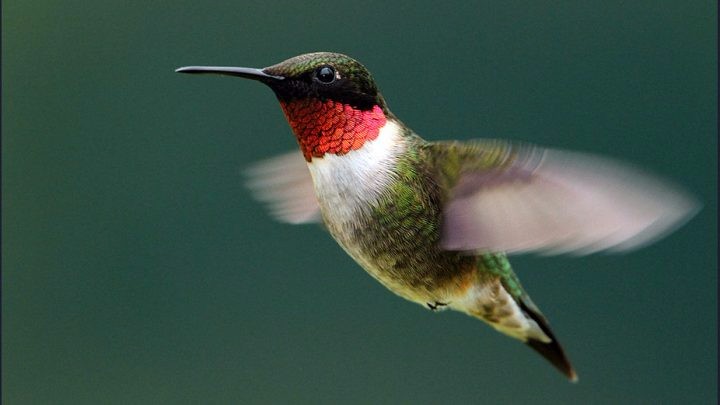
 Hummingbirds are BIG eaters. No animal on earth has a faster metabolism-roughly 100 times that of an elephant. Hummingbirds burn food so fast they often eat 1.5 to 3 times their body weight in food per day! In order to gather enough nectar, hummingbirds must visit hundreds of flowers every day.
A Ruby-throated Hummingbird weighs about 3 gram, or 1/10 an ounce. If you assume the bird eats twice its weight a day in nectar, and that it gets all its food from the feeder, that's 2/10 an ounce per day per bird. A 16-ounce feeder could thus feed 80 birds a day, assuming no leakage and no other entities are also feeding. Our Hummingbirds this year are consuming two and sometimes three liters a day.
 The Secret of Attracting Hummingbirds
1. You must be consistent and dependable.
2. You must provide a mix similar to nectar.
3. Your food supply must be available from early spring to the time they leave you in the fall.
4. Your feeders must always be clean and fresh.
The Mixture of sugar and water
Your mixture of sugar and water must be the highest concentration possible before crystallization occurs.
To achieve this fill a jar ¾ full of dry sugar and then add hot water and stir until the crystal content is absorbed into the liquid.
This mix is similar to the texture and nutritional value of nectar.
If you mix weaker mixes the birds must feed every 10 to 15 minutes and while you may be enjoying their company the birds have less time to hunt for insects and nectar and to build their nests and raise their young.
I began to feed the hummingbirds in 1986 by this method. Never were the feeders empty or dirty.
Each year their numbers increased until I was feeding them four liters of solution every day. Topping out at around 800 birds at my feeders.
A delightful adventure to see so many of these tiny, beautiful but rarely seen creatures we share life with all at once and every day.
 Here are the 21 Hummingbirds found in the U.S. and Canada. All are western birds with the exception of the Ruby-throated Hummingbird and the Bahama Woodstar:
Common Hummingbirds:
Ruby-throated Hummingbird (east)
Costa's Hummingbird (dry areas)
Anna's Hummingbird (west coast)
Broad-tailed Hummingbird (mountains)
Calliope Hummingbird (mountains)
Rufous Hummingbird (pacific northwest to Alaska)
Allen's Hummingbird (California coast)
Southwest Arizona Specialties:
Berylline Hummingbird (very rare)
Violet-crowned Hummingbird
Lucifer Hummingbird
Broad-billed Hummingbird
White-eared Hummingbird (very rare)
Blue-throated Hummingbird
Magnificent Hummingbird
Plain-capped Starthroat (very rare)
Texas Specialties:
Green Violet-ear (very rare)
Green-breasted Mango (very rare)
Buff-bellied Hummingbird
California and Florida Specialties:
Xantus's Hummingbird (CA - very, very rare)
Bahama Woodstar (FL - very, very rare)

Comments
Woman Develops Bond With Over 200 Hummingbirds, Now They Complain If She’s Late To Feed Them byIlona Baliūnaitė
UCLA (h/t: laughingsquid)
Meet Melanie Barboni, an assistant researcher in the UCLA Earth, Planetary and Space Science program, who is also known as the ‘hummingbird whisperer’. She built a community of 200 hummingbirds who live outside her office and come to complain if she’s late to serve their dinner.
Barboni has always been a bit obsessed with hummingbirds – even when she was a child in Switzerland, a country with an almost non-existant population of this species. “My dearest dream as a child was to see hummingbirds. Imagine my joy when I found out that my next job assignment would bring me to Los Angeles, where hummingbirds live year-round,” says Barboni.
The woman adds: “I cannot go to a place where they are not there… This is cheesy, but I have seen them help people. They make my life happy. Having a crappy day? Who cares — there are hummingbirds around… Having a good day? Hummingbirds make it better…”
More info:
Meet Melanie Barboni, an assistant researcher, who is also known as the ‘hummingbird whisperer’

 She built a community of 200 hummingbirds who live outside her office.


 They come to complain if she’s late to serve their dinner


 “My dearest dream as a child was to see hummingbirds”

 “Imagine my joy when I found out that my next job… would bring me… where hummingbirds live”



“I cannot go to a place where they are not there… I have seen them help people”

 “They make my life happy. Having a crappy day? Who cares — there are hummingbirds around…”


 https://www.youtube.com/watch?v=IP_3mAJpZVE
