Classical Music Alters the Brain–Here’s How

Classical Music Alters the Brain–Here’s How
 The main difference between classical and pop music is that classical music has unique rules—and the brain likes them.
Clear Evidence
One study published in the 1990s in the journal Nature drew people’s attention.
Three groups of participants were instructed to either sit in silence, listen to a relaxation tape, or listen to Mozart’s Sonata for Two Pianos in D major (K448). Ten minutes later, the group who listened to Mozart’s music showed a significant improvement in spatial IQ score—nearly 10 points higher than the other two groups.
Since then, scientists have used Mozart and other classical music in various experiments on animals and humans, confirming similar results: Listening to classical music or learning to play an instrument leads to higher school grades and stronger spatial reasoning skills, reduces the risk of brain atrophy, and slows cognitive decline.
The “Mozart effect” truly exists, said Kiminobu Sugaya, who has a doctorate in pharmacology and is a professor of medicine at the University of Central Florida College of Medicine and head of neuroscience at the Burnett School of Biomedical Sciences, during an interview with The Epoch Times. In experiments with local community residents, he found that when this type of classical music was played, “we saw a 50 percent increase in brain function.”
Certain types of classical music not only enhance cognitive abilities but are also used to treat brain disorders such as epilepsy or Parkinson’s disease. “The Mozart effect is clear evidence that you can alter the brain function and abnormalities with music,” Dr. Michael Trimble, professor emeritus of neurology and neuropsychiatry at the University College London Institute of Neurology and a Fellow of the Royal College of Physicians, told The Epoch Times. Sometimes, epilepsy is more difficult to control with medication, and using carefully selected and edited classical music to “train” the brains of epilepsy patients can normalize their brain waves and electroencephalographic abnormalities.
A study published in Interdisciplinary Science Reviews in 2022 indicated that “to this date, K448 and K545 have remained the only anti-epileptic music selections that have been verified by repeated experiments.” The study also cited data from a 2020 meta-analysis, which found that “approximately 84 percent of participants in the reviewed studies exhibited significant reductions in epileptic brain activity while listening to Mozart’s K448.”
Three groups of participants were instructed to either sit in silence, listen to a relaxation tape, or listen to Mozart’s Sonata for Two Pianos in D major (K448). Ten minutes later, the group who listened to Mozart’s music showed a significant improvement in spatial IQ score—nearly 10 points higher than the other two groups.
The “Mozart effect” truly exists, said Kiminobu Sugaya, who has a doctorate in pharmacology and is a professor of medicine at the University of Central Florida College of Medicine and head of neuroscience at the Burnett School of Biomedical Sciences, during an interview with The Epoch Times. In experiments with local community residents, he found that when this type of classical music was played, “we saw a 50 percent increase in brain function.”
What the Brain Wants
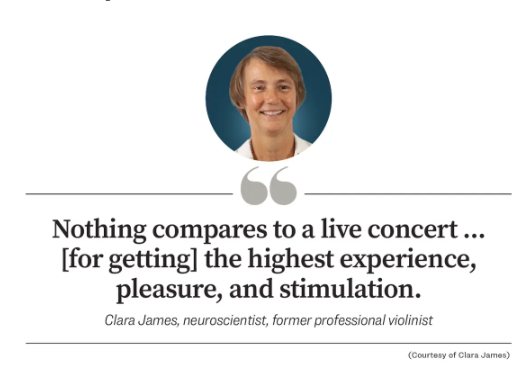
From the perspective of their impact on the human brain, the main difference between classical and pop music lies in “the complexity and structure,” Clara James, who has a doctorate in neuroscience and is a professor at the University of Applied Sciences and Arts in Geneva, Switzerland, and Privatdozent at the University of Geneva, told The Epoch Times.
Before the age of 32, Ms. James was a professional violinist.
Classical music of the common practice period (1600–1900) adheres to strict structural and harmonic rules. Even nonmusicians will notice a problem with its structure if a performer makes a minor mistake, Ms. James said.
“It places a significant emphasis on proportion, balance, and harmony,” added Ms. Yonetani.
In contrast, other forms of music may not strictly adhere to these structural rules.
The human brain “likes the rules of music,” explained Dr. Trimble. “There are certain musical sounds that are deeply embedded within the ability of our nervous system to be moved by music.” He emphasized that music contains natural rules and mathematical logic, especially classical music, where the connection to mathematics is robust. Therefore, it is universally recognized and accepted by the brain.
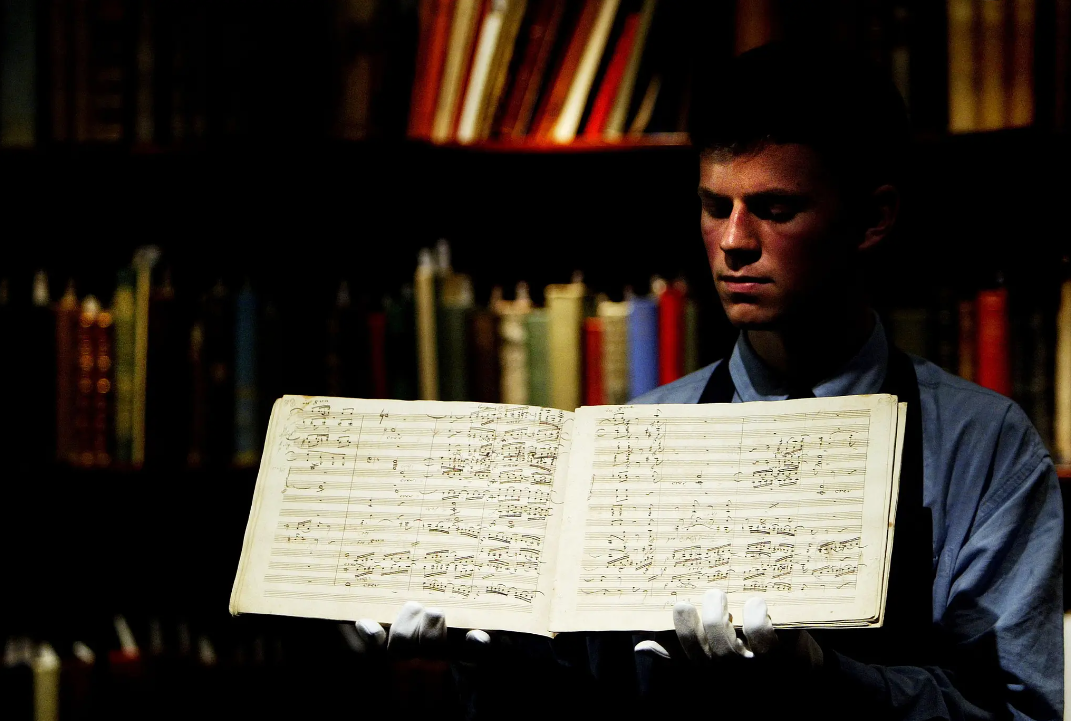 Musical notation for Beethoven's first edition of his Symphony No. 9. Classical music adheres to strict structural rules, and it places a significant emphasis on proportion, balance, and harmony. (Ian Waldie/Getty Images)
Mozart developed a truly different style of music, moving away from the earlier Baroque period, Dr. Trimble noted. Mozart’s K448, which was the first piece used to investigate the brain effect and the impact of Mozart’s music on the brain in general, “may relate to spectrogrammatic considerations—in particular, the presence of lower harmonic frequencies.
“Classical and pop music differ in so many ways,” he continued. Pop music contains continual repetition around the same musical sequences, conveying information that is often vague and banal without the subtle development and variation that occurs in the progression of classical music.
Ms. James pointed out that a typical classical music piece features a wide range of rhythms, with dynamics varying from extremely loud to very soft and extremely slow and fast sections—all seamlessly integrated. In comparison, a single pop music track has limited variability and maintains a regular rhythm.
Besides, classical music pieces are relatively long, typically ranging from 20 to 25 minutes; some are even longer, such as Gustav Mahler’s works, which can last over an hour. It carries rich information and allows the brain ample time to process it, much like slowly savoring an apple, as opposed to quickly consuming an apple-flavored gummy candy.
Furthermore, the live sound volume at modern pop music concerts can be deafening, and the singers’ and fans’ behavior can be quite wild. “You can’t hear the music because people are screaming all the time,” said Dr. Trimble.
Increased Gray Matter
As people age, their brains gradually shrink, resulting in a gradual loss of neurons. However, one study found that in orchestral musicians, certain parts of their brains do not shrink over time and can even increase in size.
MRI tests conducted under Mr. Sugaya’s supervision also had similar findings.
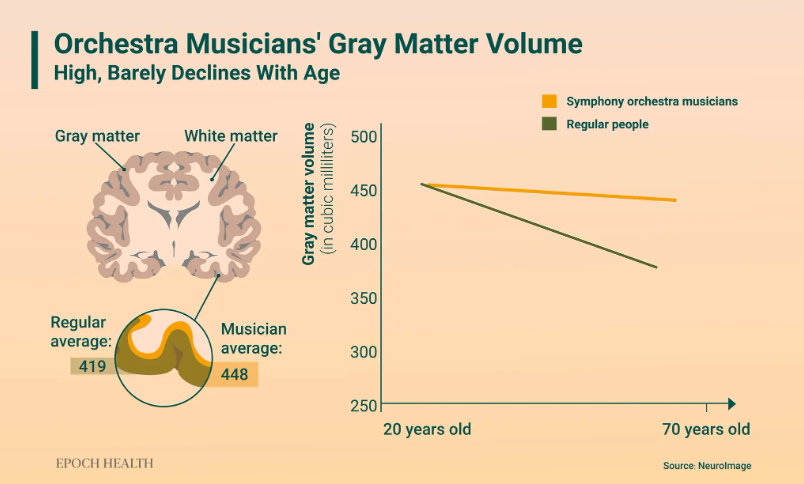
Symphony orchestra musicians have significantly higher gray matter volume than regular people, and their brain volume barely declines with age. (Illustration by The Epoch Times)
The brain is composed of gray matter and white matter. Gray matter, consisting of neurons, has been observed to increase in volume following musical activities. Ms. James explained that this increase is not due to an increase in neurons but rather “because the connections between the neurons get stronger.” On the other hand, white matter refers to short or long axons of neurons, which act together as the brain’s communication network, similar to how local roads and highways connect different cities. When listening to music, the network gets better built and oriented.
Additionally, the hippocampus—a deep brain structure—“lights up” when people listen to music attentively, said Ms. James. The hippocampus plays a critical role in cognition, memory, and emotion.
Our memory of music seems to last longer than memories of everyday events or experiences from certain stages of life. This phenomenon explains why some older individuals can effortlessly recall and sing songs or melodies they enjoyed in their youth. The hippocampus also helps people understand music. If this part of the brain is not engaged, one will not comprehend what they hear—like listening to a different language.
MRI tests conducted under Mr. Sugaya’s supervision also had similar findings.
Symphony orchestra musicians have significantly higher gray matter volume than regular people, and their brain volume barely declines with age. (Illustration by The Epoch Times) The brain is composed of gray matter and white matter. Gray matter, consisting of neurons, has been observed to increase in volume following musical activities. Ms. James explained that this increase is not due to an increase in neurons but rather “because the connections between the neurons get stronger.” On the other hand, white matter refers to short or long axons of neurons, which act together as the brain’s communication network, similar to how local roads and highways connect different cities. When listening to music, the network gets better built and oriented. Additionally, the hippocampus—a deep brain structure—“lights up” when people listen to music attentively, said Ms. James. The hippocampus plays a critical role in cognition, memory, and emotion. Our memory of music seems to last longer than memories of everyday events or experiences from certain stages of life. This phenomenon explains why some older individuals can effortlessly recall and sing songs or melodies they enjoyed in their youth. The hippocampus also helps people understand music. If this part of the brain is not engaged, one will not comprehend what they hear—like listening to a different language.
The Emotional Impact
International surveys found that over 80 percent of us cry to music, but only 18 percent and 25 percent tear up when viewing sculptures and paintings, respectively. “Music moves us,” said Dr. Trimble.
Classical music is closely linked to emotion. Dr. Trimble believes that “the actual response that we have to music is almost transcendental.”
Classical music can be more effective than other music for reducing stress and anxiety, as it typically includes moments of relaxation and calmness. “Every piece contains slow sections that help you relax,” said Ms. James. In certain therapeutic settings, such as hospitals, especially in intensive care units, the works of Mozart, Bach, and some Italian classical composers are often preferred for their superior stress-relieving and pain-reducing effects.
Jonathan Liu, a traditional Chinese medicine (TCM) practitioner and acupuncturist in Canada, told The Epoch Times that classical music has played a significant role in healing throughout history. It can also evoke a sense of sacredness, inspiring gratitude and reverence.
 Classical music can improve brain function and reduce stress. It also can evoke a sense of sacredness, inspiring gratitude and reverence. Shen Yun Symphony Orchestra performing at the Boston Symphony Hall on Oct. 13, 2018. (NTD Television)
Ms. Yonetani was told a story after playing a big concert in a European church. Halfway through her playing, an older woman sitting among the audience had slowly transitioned from sitting to kneeling on the ground, closing her eyes in devout prayer. “Personally, performing masterpieces such as Beethoven’s violin concerto or Bach Chaconne evokes a sense of awe,” she shared.
Behind the stirring of emotions lies a series of substances produced within the brain.
Music promotes the brain’s secretion of endorphins, enkephalins, dopamine, and serotonin. Each has varied biological effects, from inducing pleasure and relaxation to alleviating physical discomfort and promoting sleep.
Mr. Sugaya mentioned that attending a classical music concert is ideal for dates because dopamine released in the brain can make you appear more charming to your partner. Beautiful music can also increase oxytocin, a love hormone.
“The brain has a lot of untapped potential that humanity has not fully explored yet,” Mr. Liu remarked.
The release of dopamine induces happiness and ignites sparks in the brain’s cognitive and reward systems. Ms. James explained that when people experience chills or shivers down their spine while immersed in classical music, they’re experiencing a phenomenon in which the brain’s reward system is fully activated and aroused by such a pleasurable experience.
 Contrary to classical music’s
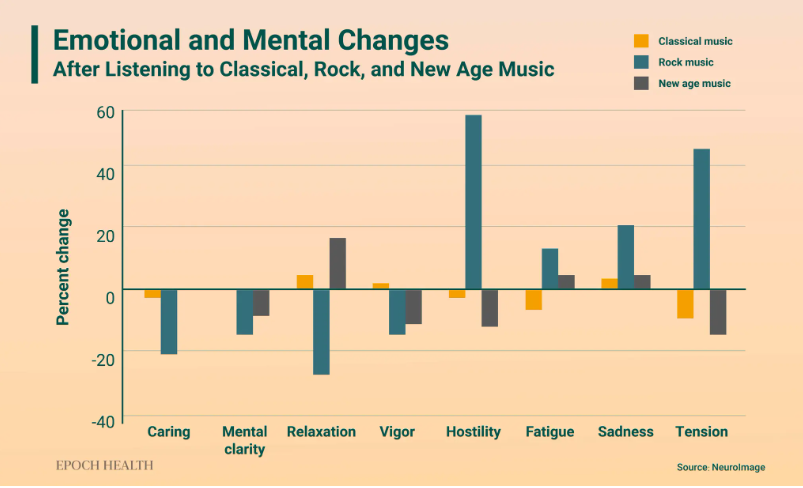
anxiety- and depression-reducing effects, some modern genres of rock music bring about excessive excitement and melancholy. When discussing young people’s preference for stimulating music, Dr. Trimble stated, “I do not believe that helps your emotional state.” Instead, he believes this music arouses anger and negative emotions.
Certain modern genres of New Age music may also negatively affect emotions.
In an older study, 144 participants of various ages listened to different music categories for 15 minutes, filling out the same questionnaire before and after listening. The results showed that classical music significantly reduced feelings of tension. Contrastingly, New Age music, while reducing feelings of tension and hostility, also lowered people’s mental clarity and vigor. Rock music not only significantly increased feelings of hostility, fatigue, sadness, and tension but also reduced people’s mental clarity and vigor and their feelings of caring and relaxation.
Classical music is closely linked to emotion. Dr. Trimble believes that “the actual response that we have to music is almost transcendental.”
Jonathan Liu, a traditional Chinese medicine (TCM) practitioner and acupuncturist in Canada, told The Epoch Times that classical music has played a significant role in healing throughout history. It can also evoke a sense of sacredness, inspiring gratitude and reverence.
Certain modern genres of New Age music may also negatively affect emotions.
