North Korea and the “Axis of Evil”


By S. Brian Willson Global Research, July 06, 2017 Global Research 22 April 2004 Region: Asia Theme: Crimes against Humanity, US NATO War Agenda In-depth Report: NORTH KOREA
This year’s US-South Korea war games in mid March involve a “hypothetical” US nuclear attack against the DPRK. The war games constitute a deliberate act of provocation by the World’s foremost military power.
The media consensus –which nobody dare to challenge– is that North Korea rather than the US is a threat to global security.
Where is the threat, North Korea or the US?
A pre-emptive nuclear war against North Korea has been on the drawing board of the Pentagon for over half a century.
Lets ask ourselves: Who is the Killer State? Who Possesses the WMDs? Who has the money and military hardware to pursue a global military agenda, in Asia, sub-Saharan Africa and the Middle East?
How could a small country of 25 million which lost 30 percent of its population as a result of US bombings in the 1950s constitute a threat to global security.
Why is this impoverished country –which has been the object of economic sanctions for the past sixty years– being threatened?
Since the end of the Korean war the threat of a US led nuclear has been relentless, for more than half a century.
Is Washington committed to world peace?
Recent history suggests that countries which are opposed to US expansionism are routinely the object of acts of aggression.
Michel Chossudovsky, Global Research, April 5, 2013, July 5, 2017
This 2004 article by award winning author, peace activist and Vietnam war veteran Brian Willson brings to light the process of demonization directed against the people of North Korea. In the words of General Curtis Lemay who led the bombing raids during the Korean war: “Over a period of three years or so we killed off – what – twenty percent of the population.” According to Brian Willson: “It is now believed that the population north of the imposed 38th Parallel lost nearly a third its population of 8 – 9 million people during the 37-month long “hot” war, 1950 – 1953, perhaps an unprecedented percentage of mortality suffered by one nation due to the belligerance of another.”
Let us carefully analyze the current context of confrontation between Washington and Pyongyang. Since the end of the Korean War, the DPRK has repeatedly put forward a proposal involving a peace treaty, the reunification of North and South Korea, the withdrawal of US troops from South Korea, the end of the conduct, on a yearly basis of a month-long U.S-South Korean war games. This year’s US-South Korea war games in mid March involve a “hypothetical” US nuclear attack against the DPRK.
The war games constitute a deliberate act of provocation by the World’s foremost military power. The media consensus –which nobody dare to challenge– is that North Korea rather than the US is a threat to global security. Where is the threat, North Korea or the US? A pre-emptive nuclear war against North Korea has been on the drawing board of the Pentagon for over half a century. Lets ask ourselves: Who is the Killer State? Who Possesses the WMDs? Who has the money and military hardware to pursue a global military agenda, in Asia, sub-Saharan Africa and the Middle East? How could a small country of 25 million which lost 30 percent of its population as a result of US bombings in the 1950s constitute a threat to global security.
Why is this impoverished country –which has been the object of economic sanctions for the past sixty years– being threatened? Since the end of the Korean war the threat of a US led nuclear has been relentless, for more than half a century. Is Washington committed to world peace? Recent history suggests that countries which are opposed to US expansionism are routinely the object of acts of aggression. Michel Chossudovsky, Global Research, April 5, 2013, July 5, 2017

 By





North Korea and the “Axis of Evil”
by S. Brian Willson
The demonization of North Korea by the United States government continues unrelentlessly. The wealthy oil and baseball man who claims to be president of the United States, used his first State of the Union address on January 29, 2002 to brand perennial enemy North Korea, along with former allies Iran and Iraq, as “the world’s most dangerous regimes” who now now form a threatening “axis of evil.” Unbeknown to the public, because it was intended to have remained a secret (whoops!), was the fact that this claimed president presented a “Nuclear Posture Review” report to Congress only three weeks earlier, on January 8, which ordered the Pentagon to prepare contingency plans for use of nuclear weapons. The first designated targets for nuclear attack were his newly identified members of the “axis of evil,” along with four other lucky nations as well – Syria, Libya, Russia, and China. That this is nothing short of a policy of ultimate terror remains unaddressed in the U.S. media.
That Koreans are deeply concerned is an understatement. However, they understand the context in which their “evil” is being portrayed, not an altogether new threat levelled at them. However, the dangerous escalation of policy rhetoric following the 9-11 tragedy now boldly warns the world of virtual total war. Vice-president Richard Cheney, another oil man from Texas, declares that the U.S. is now considering military actions against forty to fifty nations, and that the war “may never end” and “become a permanent part of the way we live.”1 The Pentagon has declared that the widening gap between the “Haves” and “Have-nots” poses a serious challenge to the U.S., requiring a doctrine of “full spectrum dominance.” Thus, the U.S. demands total capacity to conquer every place and its inhabitants in and around the Earth, from deep underground bunkers, including those in North Korea and Iraq, through land, sea, and air, to outer space. All options for achieving global and spatial hegemony are now on the table. Already, the U.S. military is deployed in 100 different countries.2 Total war, permanent war. Terror!
Addiction to use of terror by the United States is nothing new. The civilization was founded and has been sustained by use of terror as a primary policy. For example, in 1779, General George Washington ordered destruction of the “merciless Indian savages” of upstate New York, instructing his generals to “chastize” them with “terror.” The generals dutifully carried out these orders. In 1866, General William Tecumseh Sherman ordered “extermination” with vindictive earnestness of the Sioux. They were virtually exterminated. Secretary of War Elihu Root (1899-1904) under President’s McKinley and Theodore Roosevelt, justified the ruthless U.S. military conduct in the Philippines that savagely killed a half-million citizens by citing “precedents of the highest authority:” Washington’s and Sherman’s earlier orders.3
War against nations around the world is not new either. The U.S., over its history, has militarily intervened over 400 times, covertly thousands of times, in over one hundred nations.4 Virtually all these interventions have been lawless. It has bombed at least eighteen nations since it dropped Atomic bombs on Japan in 1945. It has used chemical warfare against Southeast Asia, and has provided chemical warfare agents for use by other nations such as Iraq. It has used biological warfare against China, North Korea, and Cuba. The Koreans are quite aware of most of this history. Most U.S. Americans are not. But now the U.S. has declared a unilateral terrorist war on the whole world.5
Two of the interventions in the Nineteenth Century were inflicted against Korea, the first in 1866. The second, larger one, in 1871, witnessed the landing of over 700 marines and sailors on Kanghwa beach on the west side of Korea seeking to establish the first phases of colonization. Destroying several forts while inflicting over 600 casualties on the defending Korean natives, the U.S. withdrew realizing that in order to assure hegemonic success, a much larger, permanent military presence would be necessary. The North Korean people regularly remark about this U.S. invasion, even though most in South Korea do not know of it due to historic censorship. Most in the U.S. don’t know about it either, for similar reasons, even though in all of the Nineteenth Century, this was the largest U.S. military force to land on foreign soil outside of Mexico and Canada until the “Spanish American War” in 1898.
North Korea and the “Axis of Evil” by S. Brian Willson The demonization of North Korea by the United States government continues unrelentlessly. The wealthy oil and baseball man who claims to be president of the United States, used his first State of the Union address on January 29, 2002 to brand perennial enemy North Korea, along with former allies Iran and Iraq, as “the world’s most dangerous regimes” who now now form a threatening “axis of evil.” Unbeknown to the public, because it was intended to have remained a secret (whoops!), was the fact that this claimed president presented a “Nuclear Posture Review” report to Congress only three weeks earlier, on January 8, which ordered the
Pentagon to prepare contingency plans for use of nuclear weapons. The first designated targets for nuclear attack were his newly identified members of the “axis of evil,” along with four other lucky nations as well – Syria, Libya, Russia, and China. That this is nothing short of a policy of ultimate terror remains unaddressed in the U.S. media. That Koreans are deeply concerned is an understatement. However, they understand the context in which their “evil” is being portrayed, not an altogether new threat levelled at them.
However, the dangerous escalation of policy rhetoric following the 9-11 tragedy now boldly warns the world of virtual total war. Vice-president Richard Cheney, another oil man from Texas, declares that the U.S. is now considering military actions against forty to fifty nations, and that the war “may never end” and “become a permanent part of the way we live.”1 The Pentagon has declared that the widening gap between the “Haves” and “Have-nots” poses a serious challenge to the U.S., requiring a doctrine of “full spectrum dominance.”
Thus, the U.S. demands total capacity to conquer every place and its inhabitants in and around the Earth, from deep underground bunkers, including those in North Korea and Iraq, through land, sea, and air, to outer space. All options for achieving global and spatial hegemony are now on the table. Already, the U.S. military is deployed in 100 different countries. *2 Total war, permanent war. Terror! Addiction to use of terror by the United States is nothing new.
The civilization was founded and has been sustained by use of terror as a primary policy. For example, in 1779, General George Washington ordered destruction of the “merciless Indian savages” of upstate New York, instructing his generals to “chastize” them with “terror.” The generals dutifully carried out these orders. In 1866, General William Tecumseh Sherman ordered “extermination” with vindictive earnestness of the Sioux. They were virtually exterminated. Secretary of War Elihu Root (1899-1904) under President’s McKinley and Theodore Roosevelt, justified the ruthless U.S. military conduct in the Philippines that savagely killed a half-million citizens by citing “precedents of the highest authority:” Washington’s and Sherman’s earlier orders.*3 War against nations around the world is not new either.
The U.S., over its history, has militarily intervened over 400 times, covertly thousands of times, in over one hundred nations.*4 Virtually all these interventions have been lawless. It has bombed at least eighteen nations since it dropped Atomic bombs on Japan in 1945. It has used chemical warfare against Southeast Asia, and has provided chemical warfare agents for use by other nations such as Iraq. It has used biological warfare against China, North Korea, and Cuba.
The Koreans are quite aware of most of this history. Most U.S. Americans are not. But now the U.S. has declared a unilateral terrorist war on the whole world.5 Two of the interventions in the Nineteenth Century were inflicted against Korea, the first in 1866. The second, larger one, in 1871, witnessed the landing of over 700 marines and sailors on Kanghwa beach on the west side of Korea seeking to establish the first phases of colonization. Destroying several forts while inflicting over 600 casualties on the defending Korean natives, the U.S. withdrew realizing that in order to assure hegemonic success, a much larger, permanent military presence would be necessary.
The North Korean people regularly remark about this U.S. invasion, even though most in South Korea do not know of it due to historic censorship. Most in the U.S. don’t know about it either, for similar reasons, even though in all of the Nineteenth Century, this was the largest U.S. military force to land on foreign soil outside of Mexico and Canada until the “Spanish American War” in 1898.
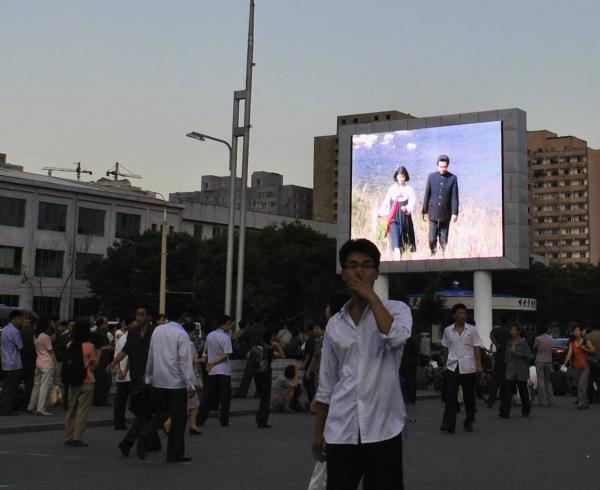 Pyongyang. Capital of the DPRK
I believe it important for U.S. Americans to place themselves in the position of people living in targeted countries. That North Korea, a nation of 24 million people, i.e., one-twentieth the population of the U.S., many of them poor, a land slightly larger in area than the U.S. state of Pennsylvania, continues to be one of the most demonized nations and least understood, totally perplexes the Korean people. It is worthwhile to seek an understanding of their perspective.
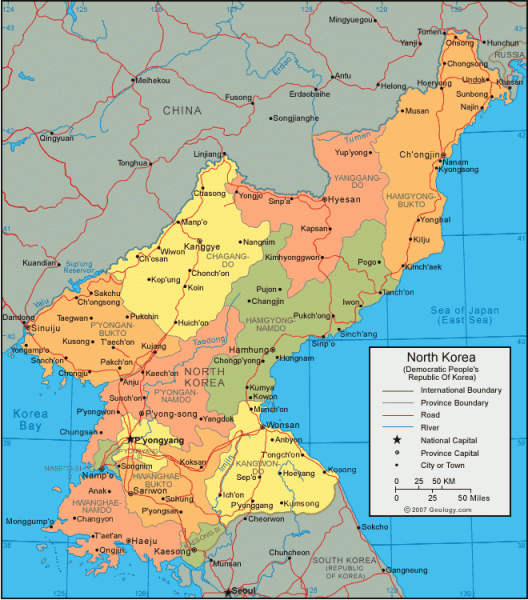
I recently visited that nation and talked with a number of her citizens. I travelled 900 ground miles through six of North Korea’s nine provinces, as well as spending time in Pyongyang, the capital, and several other cities. I talked with dozens of people from all walks of life. Though times have been hard for North Koreans, especially in the 1990s, they long ago proudly rebuilt all of their dozens of cities, thousands of villages, and hundreds of dykes and dams destroyed during the war.
U.S. interference into the sovereign life of Korea immediately upon the 1945 surrender of the hated Japanese, who had occupied the Korean Peninsula for forty years, is one of the major crimes of the Twentieth Century, from which the Korean people have never recovered. (SEE “United States Government War Crimes,” Spring 2002 – issue # 1 of Global Outlook). From a North Korean’s perspective they
(1) have vigorously opposed the unlawful and egregious division of their country from day one to the present,
(2) were blamed for starting the “Korean War” which in fact had been a struggle between a minority of wealthy Koreans supporting continued colonization in collaboration with the U.S. and those majority Koreans who opposed it,
(3) proudly and courageously held the U.S. and its “crony U.N. allies” to a stalemate during the “War,” and
(4) have been tragically and unfairly considered a hostile nation ever since. They have not forgotten the forty years of Japanese occupation that preceded the U.S. imposed division and subsequent occupation that continues in the South. They deeply yearn for reunification of their historically unified culture.
Pyongyang. Capital of the DPRK I believe it important for U.S. Americans to place themselves in the position of people living in targeted countries. That North Korea, a nation of 24 million people, i.e., one-twentieth the population of the U.S., many of them poor, a land slightly larger in area than the U.S. state of Pennsylvania, continues to be one of the most demonized nations and least understood, totally perplexes the Korean people. It is worthwhile to seek an understanding of their perspective.
I recently visited that nation and talked with a number of her citizens. I travelled 900 ground miles through six of North Korea’s nine provinces, as well as spending time in Pyongyang, the capital, and several other cities. I talked with dozens of people from all walks of life. Though times have been hard for North Koreans, especially in the 1990s, they long ago proudly rebuilt all of their dozens of cities, thousands of villages, and hundreds of dykes and dams destroyed during the war. U.S. interference into the sovereign life of Korea immediately upon the 1945 surrender of the hated Japanese, who had occupied the Korean Peninsula for forty years, is one of the major crimes of the Twentieth Century, from which the Korean people have never recovered. (SEE “United States Government War Crimes,” Spring 2002 – issue # 1 of Global Outlook).
From a North Korean’s perspective they
(1) have vigorously opposed the unlawful and egregious division of their country from day one to the present,
(2) were blamed for starting the “Korean War” which in fact had been a struggle between a minority of wealthy Koreans supporting continued colonization in collaboration with the U.S. and those majority Koreans who opposed it,
(3) proudly and courageously held the U.S. and its “crony U.N. allies” to a stalemate during the “War,” and
(4) have been tragically and unfairly considered a hostile nation ever since. They have not forgotten the forty years of Japanese occupation that preceded the U.S. imposed division and subsequent occupation that continues in the South. They deeply yearn for reunification of their historically unified culture.
 Everyone I talked with, dozens and dozens of folks, lost one if not many more family members during the war, especially from the continuous bombing, much of it incendiary and napalm, deliberately dropped on virtually every space in the country. “Every means of communication, every installation, factory, city, and village” was ordered bombed by General MacArthur in the fall of 1950. It never stopped until the day of the armistice on July 27, 1953. The pained memories of people are still obvious, and their anger at “America” is often expressed, though they were very welcoming and gracious to me. Ten million Korean families remain permanently separated from each other due to the military patrolled and fenced dividing line spanning 150 miles across the entire Peninsula.
Let us make it very clear here for western readers. North Korea was virtually totally destroyed during the “Korean War.” U.S. General Douglas MacArthur’s architect for the criminal air campaign was Strategic Air Command head General Curtis LeMay who had proudly conducted the earlier March 10 – August 15, 1945 continuous incendiary bombings of Japan that had destroyed 63 major cities and murdered a million citizens. (The deadly Atomic bombings actually killed far fewer people.)
Eight years later, after destroying North Korea’s 78 cities and thousands of her villages, and killing countless numbers of her civilians, LeMay remarked, “Over a period of three years or so we killed off – what – twenty percent of the population.”6 It is now believed that the population north of the imposed 38th Parallel lost nearly a third its population of 8 – 9 million people during the 37-month long “hot” war, 1950 – 1953, perhaps an unprecedented percentage of mortality suffered by one nation due to the belligerance of another.
Virtually every person wanted to know what I thought of Bush’s recent accusation of North Korea as part of an “axis of evil.” Each of the three governments comprising Bush’s “axis of evil” of course immediately condemned the remarks, North Korea being no exception. I shared with them my own outrage and fears, and they seemed relieved to know that not all “Americans” are so cruel and bellicose. As with people in so many other nations with whom the U.S. has treated with hostility, they simply cannot understand why the U.S. is so obsessed with them.
Koreans were relieved to learn that a recent poll had indicated eighty percent of South Koreans were against the U.S. belligerant stance against their northern neighbors.
The North Korean government described Bush as a “typical rogue and a kingpin of terrorism” as he was visiting the South in February, only three weeks after presenting his threatening State of the Union address.7 It was also encouraging that the two Koreas resumed quiet diplomatic talks in March just as the U.S. and South Korea were once again conducting their regular, large-scale, joint military exercises so enraging to the North, and to an increasing number of people in the South among the growing reunification movement there. *8
In the English-language newspaper, The Pyongyang Times, (February 23, 2002) there were articles entitled “US Is Empire of the Devil,” Korea Will Never Be a Threat to the US,” and “Bush’s Remarks Stand Condemned.” Quite frankly, all three of these articles relate a truth about the U.S. that would draw a consensus from many quarters around the world.
While in country, together we listened to Bush’s March 14 Voice of America (VOA) radio chastizement of North Korea.
First, he stated that the North’s 200,000 prisoner population was proof of terrible repression. Though I had no way of knowing the number of prisoners in the North, any more than Bush did, I do know that the United States has 2 million prisoners which is similar in per-capita detention rate to that of North Korea if the 200,000 figure is accurate. Furthermore, the U.S. has a minimum of 3 million persons, mostly minority and poor, under state supervision of parole and probation. The U.S. sweeps its class and race problems into prison.
Second, Bush declared that half the population was considered unreliable and, as a result, received less monthly food rations. The Koreans are a proud people living in a Confucian tradition, having rebuilt their nation from virtual total destruction during the Korean war. I did not notice any obvious display of dissent. That some Koreans are desperate due to lack of food, water, and heat, especially in some rural areas, does not necessarily translate into dissent, though some are seeking relief by travel to neighboring countries.*9
Third, Bush claimed that Koreans who listen to foreign radio are targeted for execution. Together we regularly listened to U.S.VOA radio broadcasts and they freely discussed the content of the broadcasts without fear of reprisals.
Fourth, Bush condemned the DPRK for spending too much on its military, causing food shortages for the people. Note: Again it must be remembered that it was the U.S. that unilaterally divided Korea following the Japanese surrender in August 1945, and subsequently ruled with a military occupation government in the south, overseeing the elimination of virtually the entire popular movement of (majority) opposition to U.S. occupation, murdering hundreds of thousands of people.
The consequent Korean civil war that openly raged in 1948-1950 was completely ignored when the U.S. defined the beginning of the Korean War in 1950. The U.S. remains at war with the DPRK, never having signed a peace treaty with her. The war has left a deep scar in the Korean character with a memory that is regularly provoked by continued belligerance directed at the DPRK. The U.S. regularly holds joint military exercises with South Korean military forces aimed at the DPRK. The U.S. retains 37,000 military troops at 100 installations south of the 38th parallel.
The U.S. has its largest Asian bombing range where it practices bombs five days a week, fifty-two weeks a year, despite opposition from many South Koreans. And now Bush has identified North Korea as part of an “axis of evil” targeted for nuclear attack. This is no remote idea to North Koreans. The U.S. possesses nuclear weapons on ships and planes in the Pacific region surrounding North Korea. Virtually every nation in this perilous position would be concerned about their defense.
It is worth noting that the United States is the leading military spender in the world resulting in substantial underfunding of its own indispensable social programs.
Fifth, Bush accused the DPRK of selling weapons to other nations. That is like the pot calling the kettle black. The U.S. is by far the largest manufacturer of conventional, nuclear, chemical, and biological weapons in the world. It is also the largest seller of these weapons, and has used conventional (against dozens of nations), biological (Cuba, China, Korea, perhaps others), chemical (Southeast Asia), and nuclear (Japan, and threatened to use them on at least 20 other occasions) weapons. In addition it has armed other nations with these weapons of mass destruction, including Iraq, one of those countries now identified as part of the “axis of evil.” In the year 2000, international arms sales were nearly $37 billion, with the U.S. being directly responsible for just over half of those sales. South Korea was the third largest buyer of weapons from the United States with $3.2 worth of military hardware.10 And in January 2002, South Korea was seriously contemplating purchasing an additional $3.2 billion worth of 40 F-X fighter jets from U.S. arms giant Boeing.
At the conclusion of this VOA radio broadcast, Koreans and I looked at each other in disbelief. But we also knew that we were in solidarity with each other as part of the human family. When I said goodbye to my new friends we embraced knowing that we live in a single world made up of a rich diversity of ideas and species. We know that we are going to live or die together, and hope that the arrogant and dangerous rhetoric and militarism of the United States will soon end so we can all live in peace. However, for that to happen, there will need to be a dramatic awakening among the people and a corresponding expression of massive nonviolent opposition that will make such threatening behavior impossible to carry out.
Notes
1. Bob Woodward, “CIA Told To Do ‘Whatever Necessary’ to Kill Bin Laden,” The Washington Post, October 21, 2001.
2. Bradley Graham, “Pentagon Plans New Command For U.S. Four Star Officer, Would Over See Homeland Defense,” The Washington Post, January 26, 2002.
3. Richard Drinnon, Facing West: The Metaphysics of Indian Hating and Empire Building. New York: Schocken Books, 1990, p. 329.
4. B.M. Blechman and S.S. Kaplan, Force Without War: U.S. Armed Forces As A Political Instrument. Wash., D.C.: The Brookings Institution, 1978, Appendix B; Congressional Research Service (Foreign Affairs and National Defense Division), Instances of United States Armed Forces Abroad, 1798-1993. Wash., D.C.: Congressional Research Service, 1993; William Blum, Killing Hope: U.S. Military and CIA Intervention Since World War II. Monroe, ME: Common Courage Press, 1995; John Stockwell, The Praetorian Guard.Cambridge, MA: South End Press, 1991.
5. William Blum, Rogue State. Monroe, ME: Common Courage Press, 2000; Stephan Endicott and Edward Hagerman, The United States and Biological Warfare: Secrets From the Early Cold War and Korea. Bloomington, IN: Indiana University Press, 1998.
6. Richard Rhodes, “The General and World War III,” The New Yorker, June 19, 1995, p. 53.
7.”North Korea Calls Bush ‘Kingpin of Terrorism,” Reuters wire story, February 23, 2002.
8.”South Korea Envoy to Travel North,” BBC News Online: World: Asia-Pacific, March 25, 2002. Retrieved March 26, 2002, from http://news.bbc.co.uk/low/english/world/asia-pacific/newsid_1891000/1891457.stm
9. Ji-Yeon Yuh, “North Korean Enemy Should Be Made Friend,” The Baltimore Sun, February 27, 2002.
10. Thom Shanker, “Global Arms Sales Rise Again, and the U.S. Leads the Pack, ” The New York Times, August 20, 2001.
S. Brian Willlson is a Vietnam veteran, long-time peace activist, and writer. He has visited a number of countries studying the impacts of U.S. policy. His essays are posted on his website, brianwillson.com. He published a small autobiography, On Third World Legs (Charles Kerr, 1992), which describes his ordeal of having been intentionally run over by a U.S. Government munitions train accelerating to over three times the 5 mph legal speed limit during a peaceful protest in California in 1987. He now walks on two prostheses after losing each leg below the knee. Brian Willson possesses two honorary Ph.D.s and a Juris Doctor degree.
The original source of this article is Global Research
Copyright © S. Brian Willson, Global Research, 2017
Comment on Global Research Articles on our Facebook page
Become a Member of Global Research
Global Research Canada


